Summer 2026 · Capstone
Ghost Canopy
- Term
- Summer 2026 · 6 credit hours
- Recognition
- Submission in progress, Memorial to the Sixth Extinction open international ideas competition
- Type
- Capstone
- Site
- Talladega National Forest, Alabama
- Scale
- Large
- Method
- Systems Based Thinking, Operative Abstraction
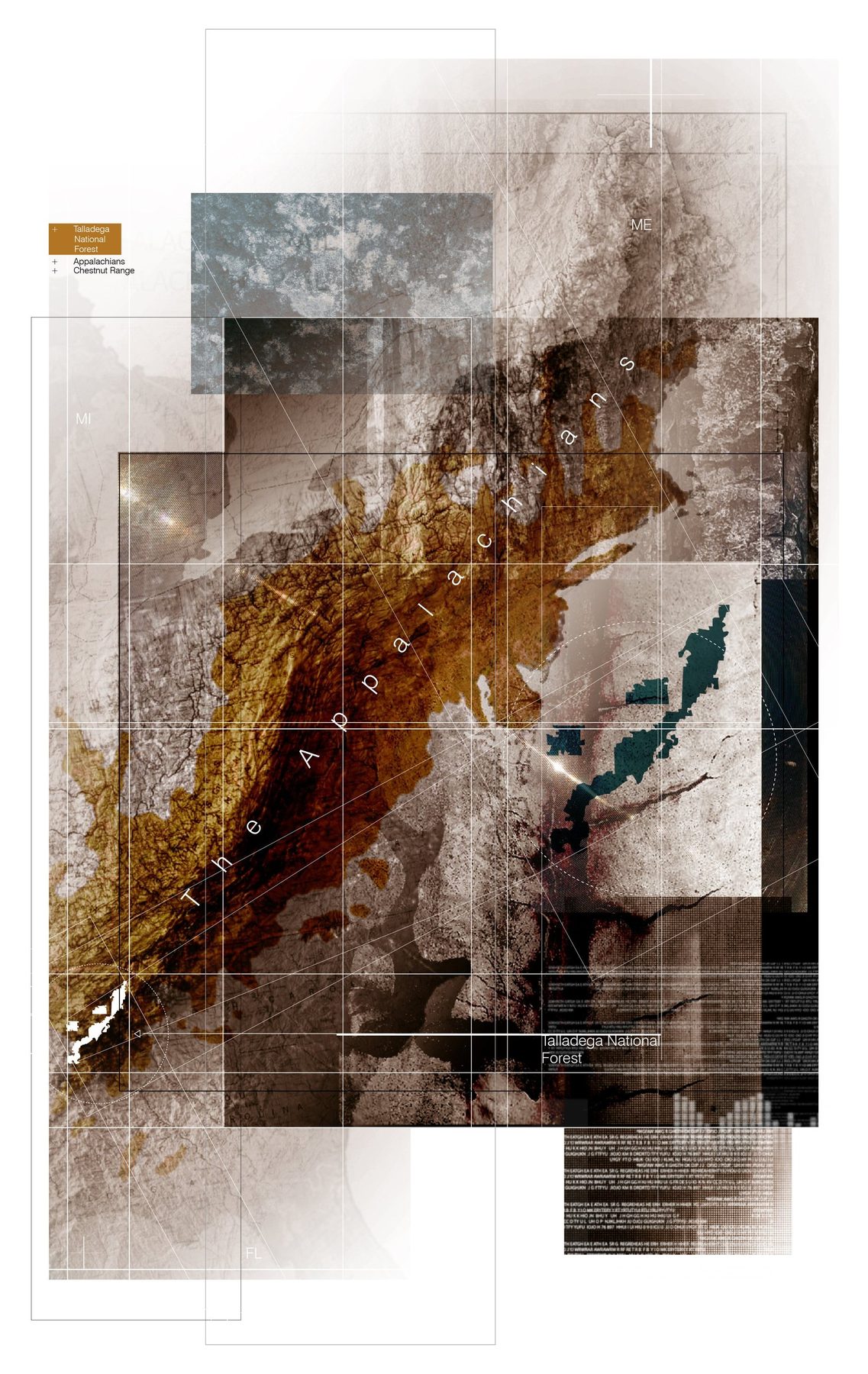
The Appalachians represent one of the most biodiverse regions on the planet. Among the species it used to host was Castanea dentata, the American chestnut, which served as a vital resource for the habitat, where a single tree would support thousands of insects, provide nutrients to birds, small mammals, and reptiles, and act as a canvas for endemic moss and lichen, which helped cool the air.
In the early 1900s, a blight brought from Asia ravaged 94% of their population, permanently affecting Appalachian biodiversity. Talladega National Forest, at the southern tip of the Appalachians, is one of the places affected by this blight. Even though it is lush and green, the sylvan scars remain, and so do the lessons they teach us.
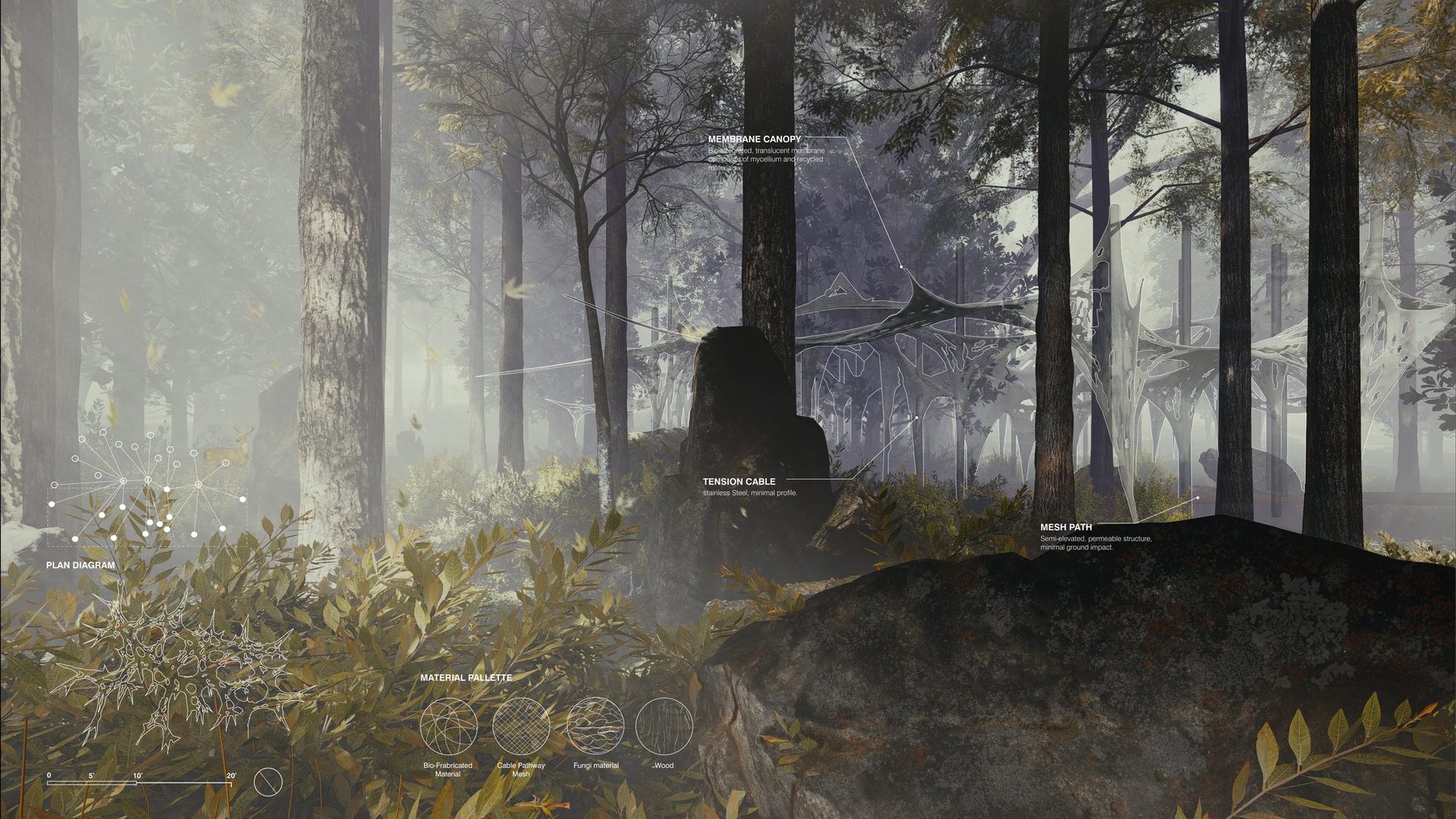
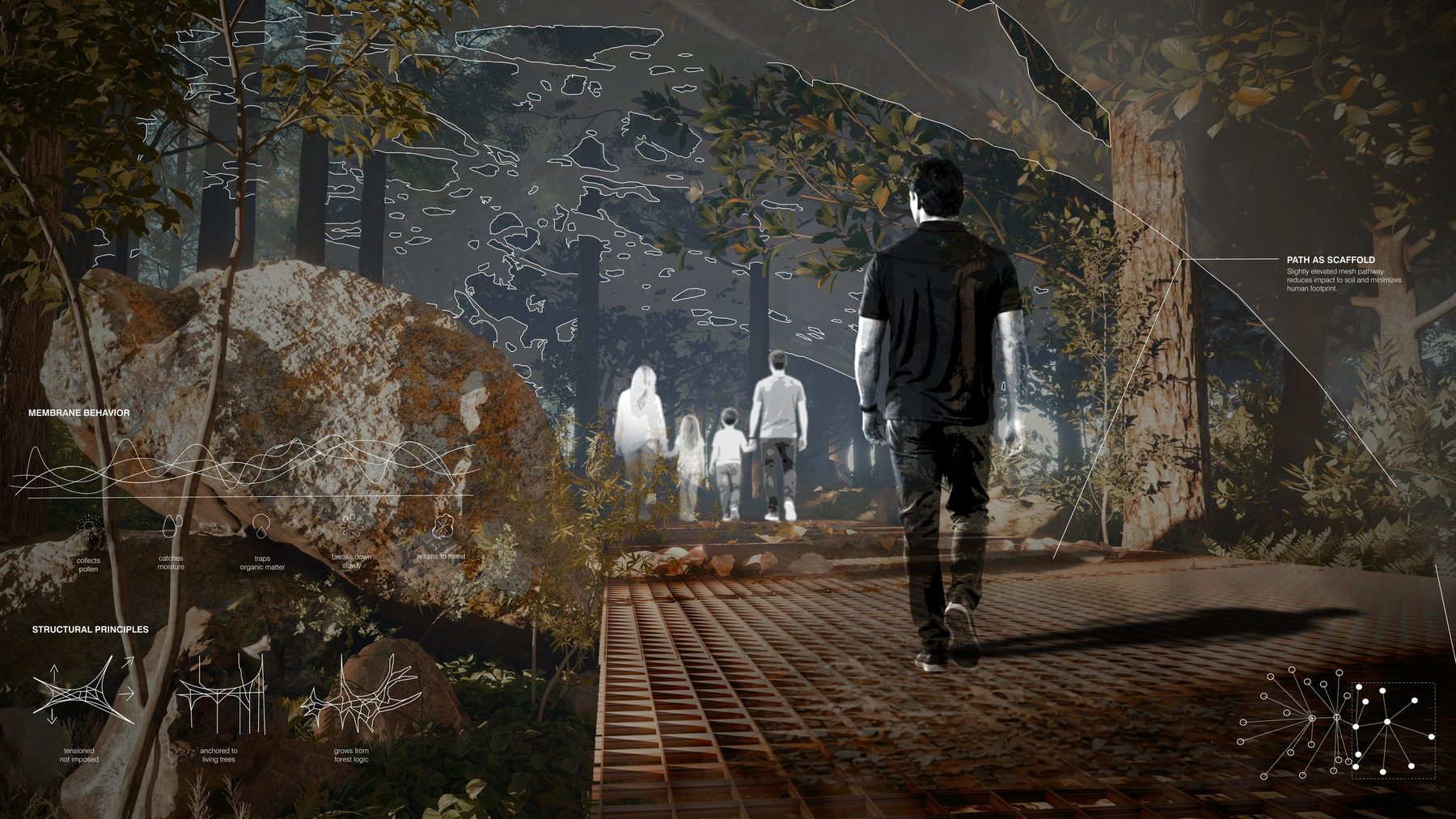
The Ghost Canopy is a changing structure woven through the forest that makes visible what has disappeared while creating niche habitats for wildlife. People move off the forest trails, walking under a unique canopy of varying transparencies and forms.
Above: Membrane canopy in the understory, Talladega National Forest
The range
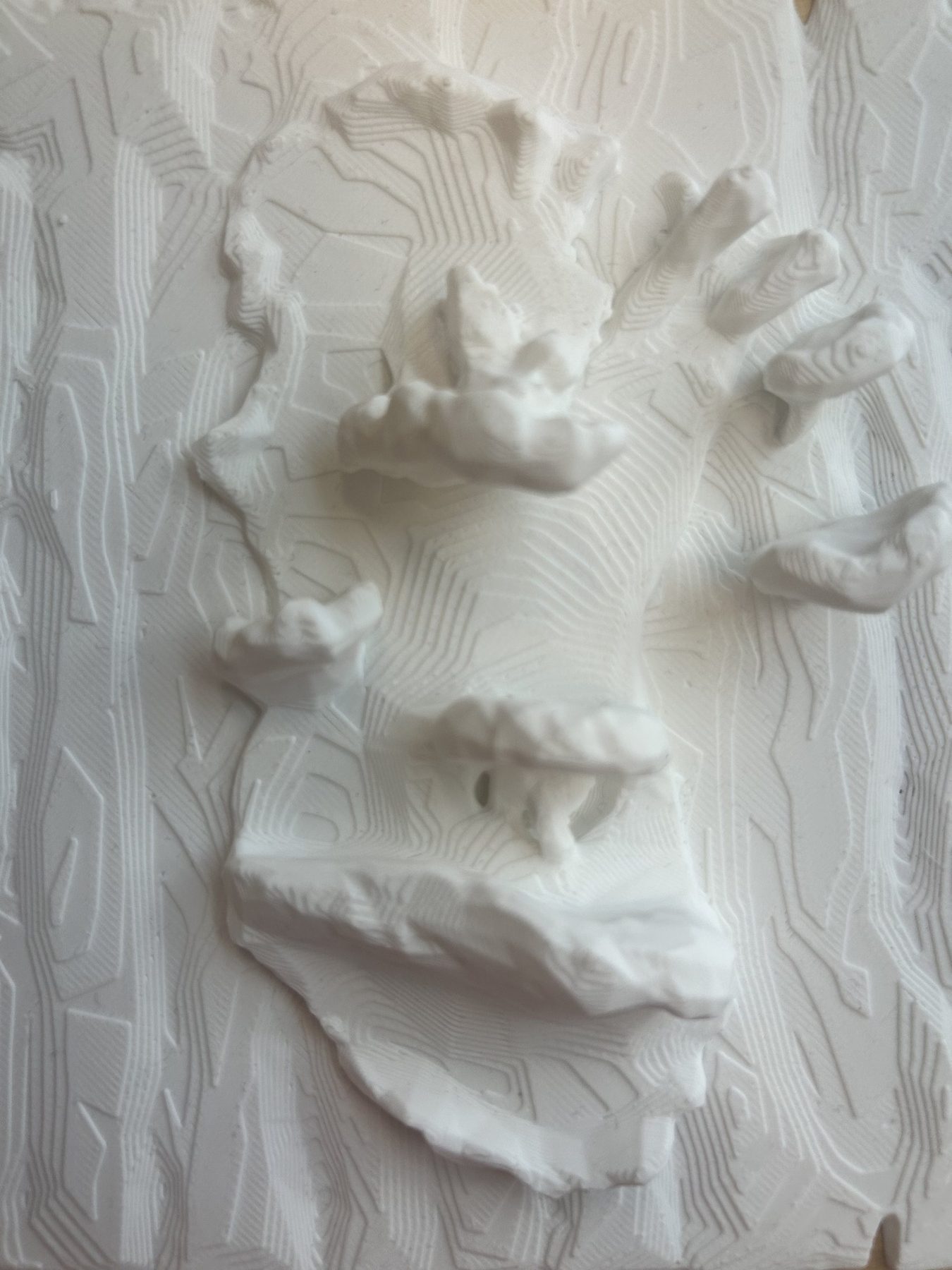
The chestnut range once ran the length of the Appalachians. Talladega National Forest sits at its southern tip, which is where the project lands. The collage reads the range as a data field rather than a map, layering terrain, bark, and lichen at the same scale so the loss registers as territory rather than as a statistic.
Cryphonectria parasitica
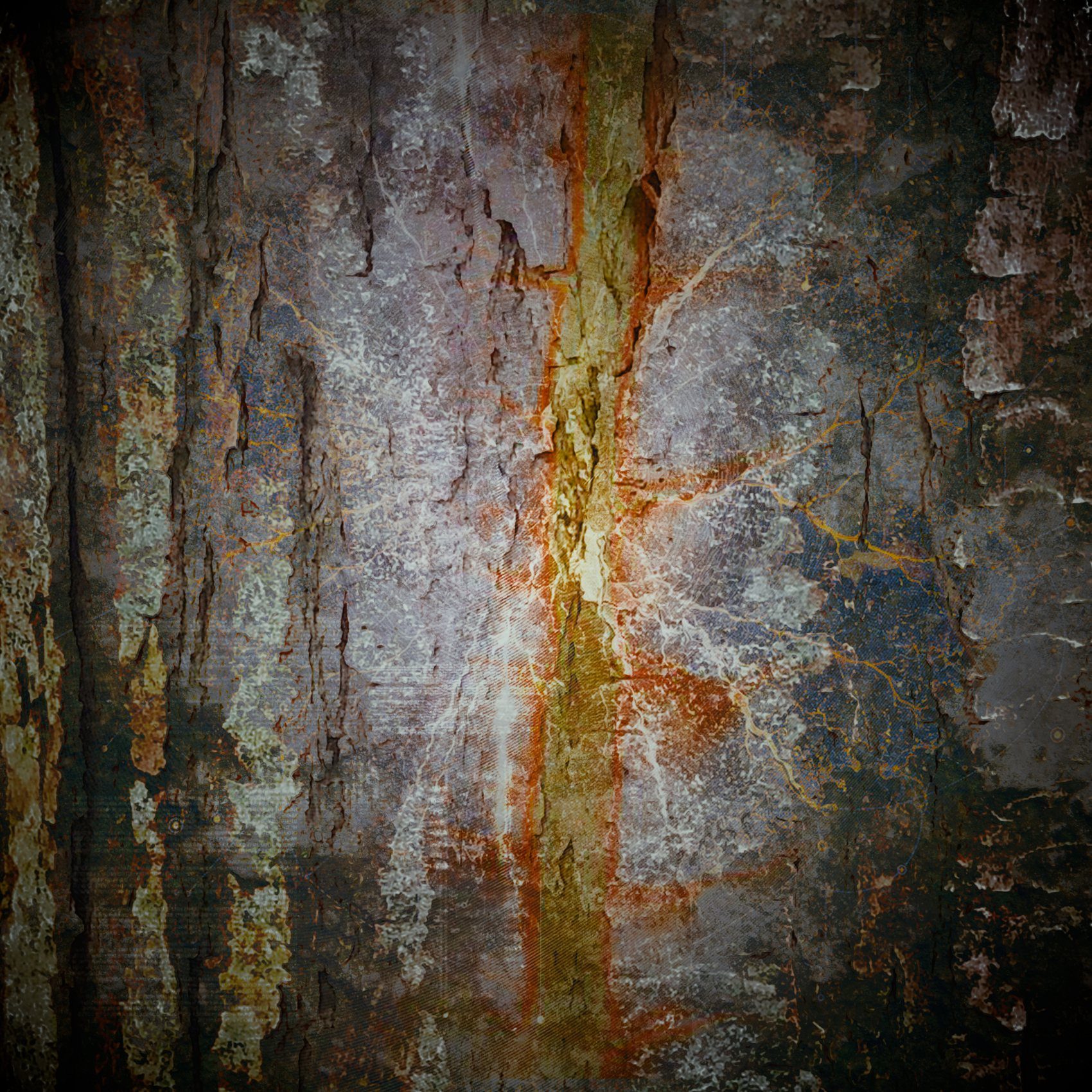
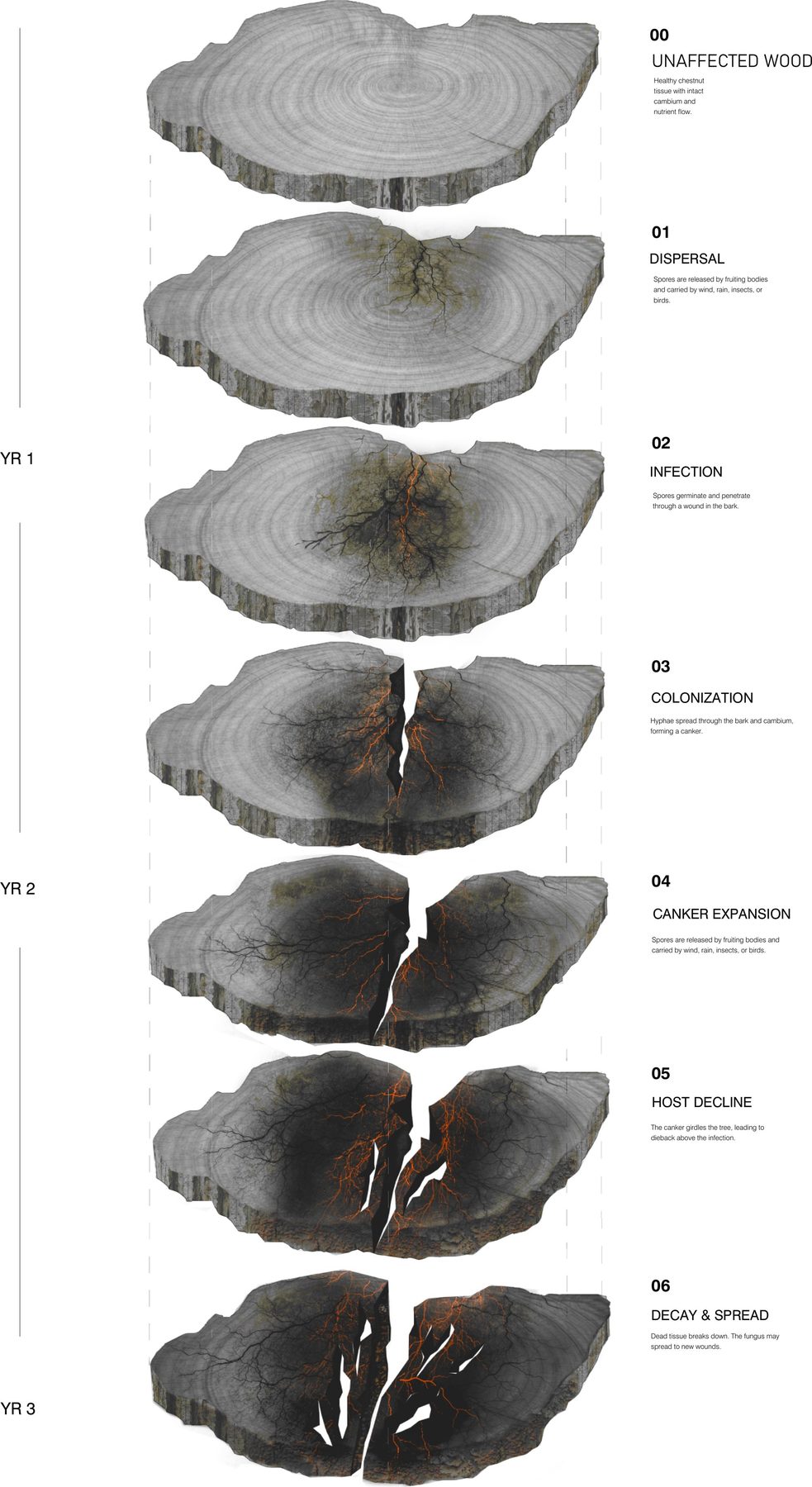
Chestnut blight kills from a wound inward. The section series follows one tree across three years, from intact cambium through infection, canker expansion, and girdling, to the point where dead tissue breaks down and the fungus moves to the next wound. Drawing the sequence rather than the endpoint is what makes the loss legible as a process.
Design language from the survivors
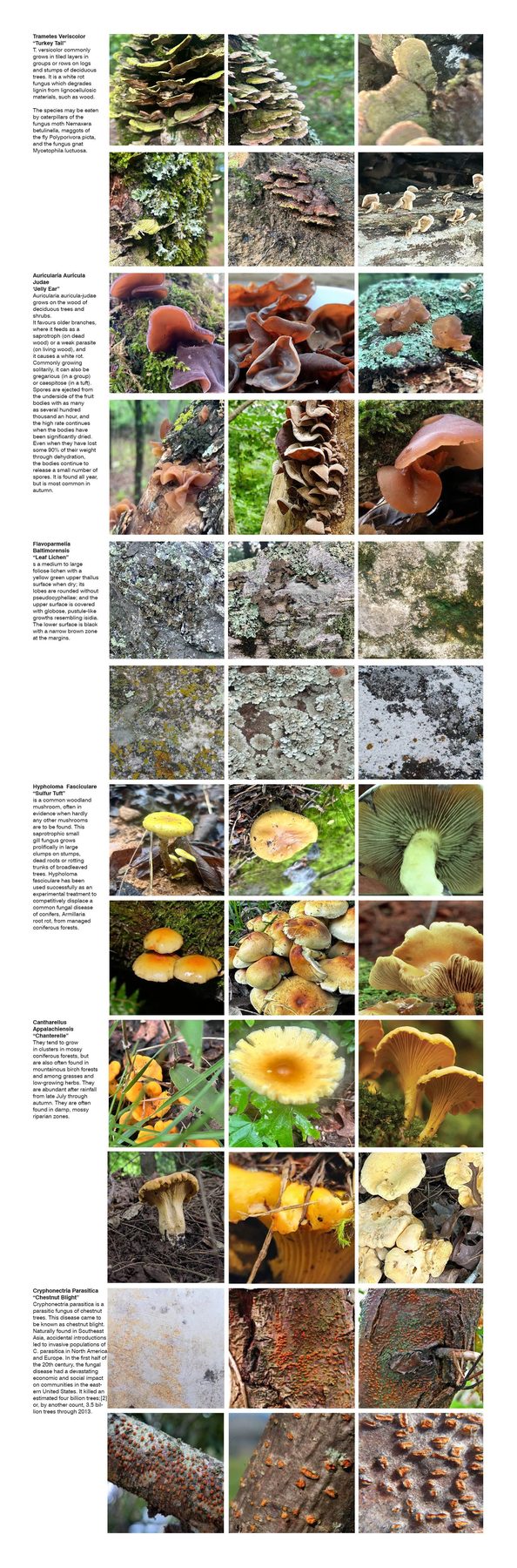
The canopy repurposes design language from endemic fungi species: Trametes versicolor, Cantharellus appalachiensis, Auricularia auricula-judae, Hypholoma fasciculare, Flavoparmelia baltimorensis, and the lichen Japewiella dollypartoniana. They all exist on the fringes of the forest, sprouting from dead trees, scattered among the forest floor, draping themselves across the biome in silent composure. On closer inspection they show sweeping forms, organic repetition, and a controlled chaos only found in nature. The project observes these forms and deconstructs how they integrate ecologically.
Sylvan thresholds
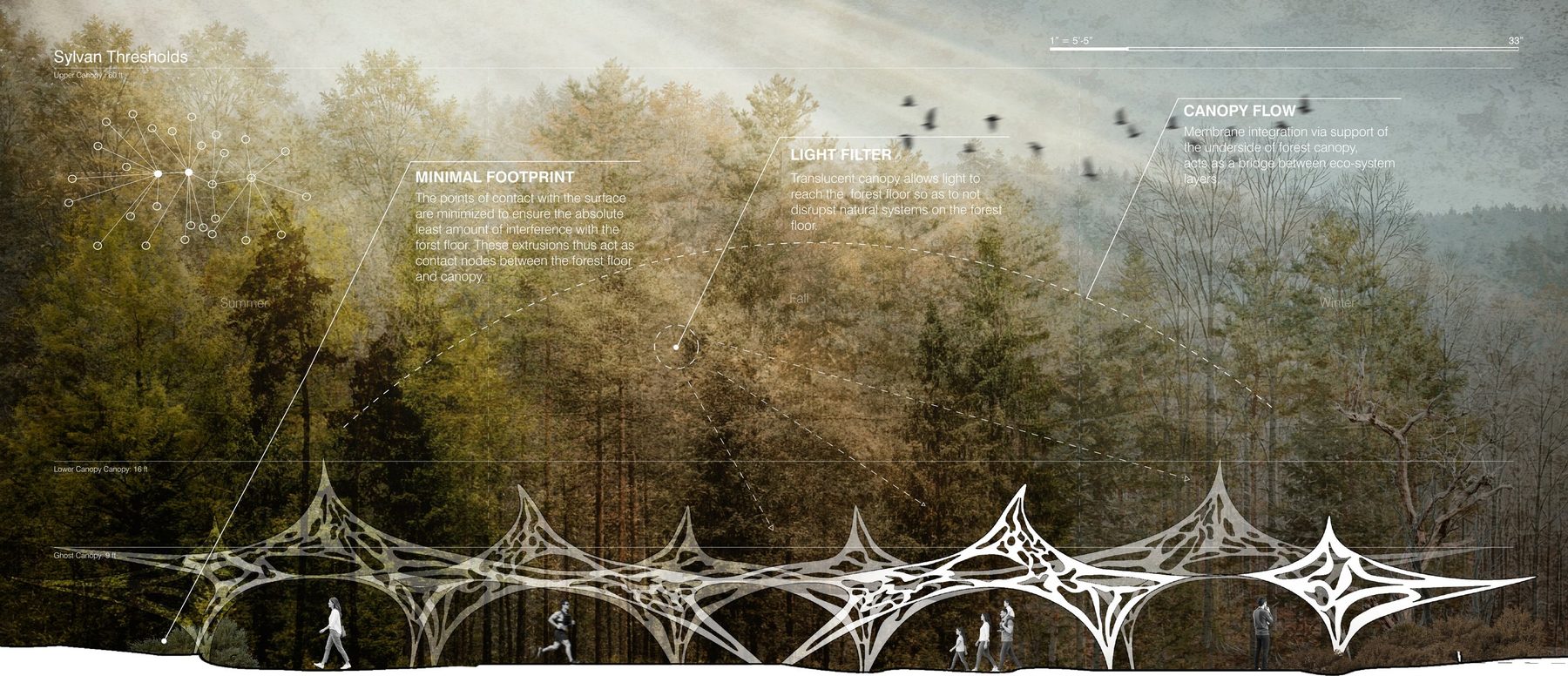
The section holds three canopy heights at once: the upper canopy at 60 feet, the lower canopy at 16 feet, and the ghost canopy at 9 feet. Contact with the ground is minimized to a set of nodes, so the structure bridges between ecosystem layers instead of occupying the forest floor. The membrane is translucent, which keeps light reaching what grows below it.
Walking under
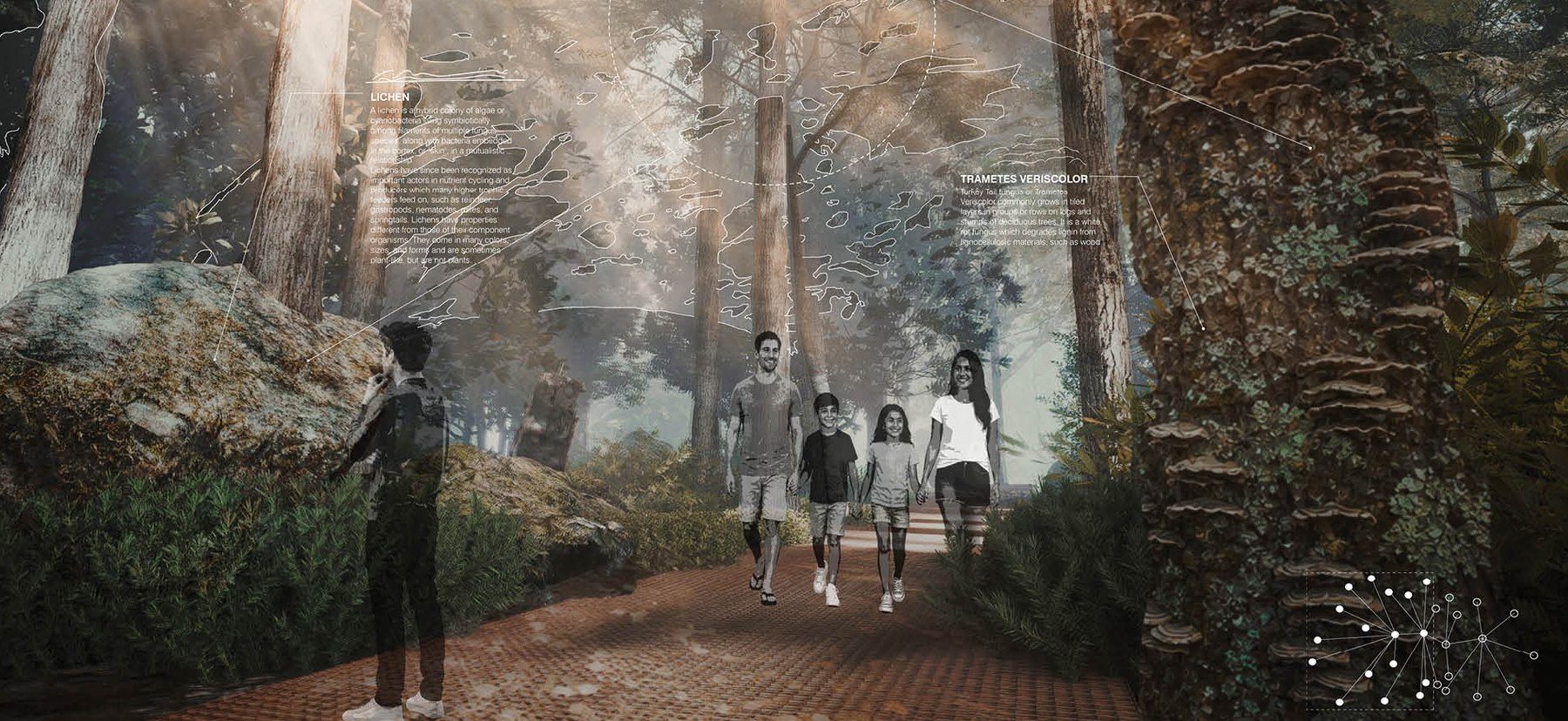
Visitors leave the forest trail for a semi-elevated mesh path. The membrane is bio-fabricated from mycelium and recycled material, tensioned on stainless cable, and perforated with thousands of small openings that react to temperature, humidity, and carbon emissions. It collects pollen, catches moisture, traps organic matter, breaks down slowly, and returns to the forest.
The board
The full capstone board, titled COLONIZ[ing]. Built in D5 Render, Adobe Photoshop, Illustrator, and After Effects.
![COLONIZ[ing]: full presentation board](img/gc-board.jpg)